
PArt 9 | Huike: The Zen (Chan) Master They Killed
How Direct Insight Challenges Authority
“What kind of teaching becomes dangerous enough that someone bribes the authorities to kill the teacher?”
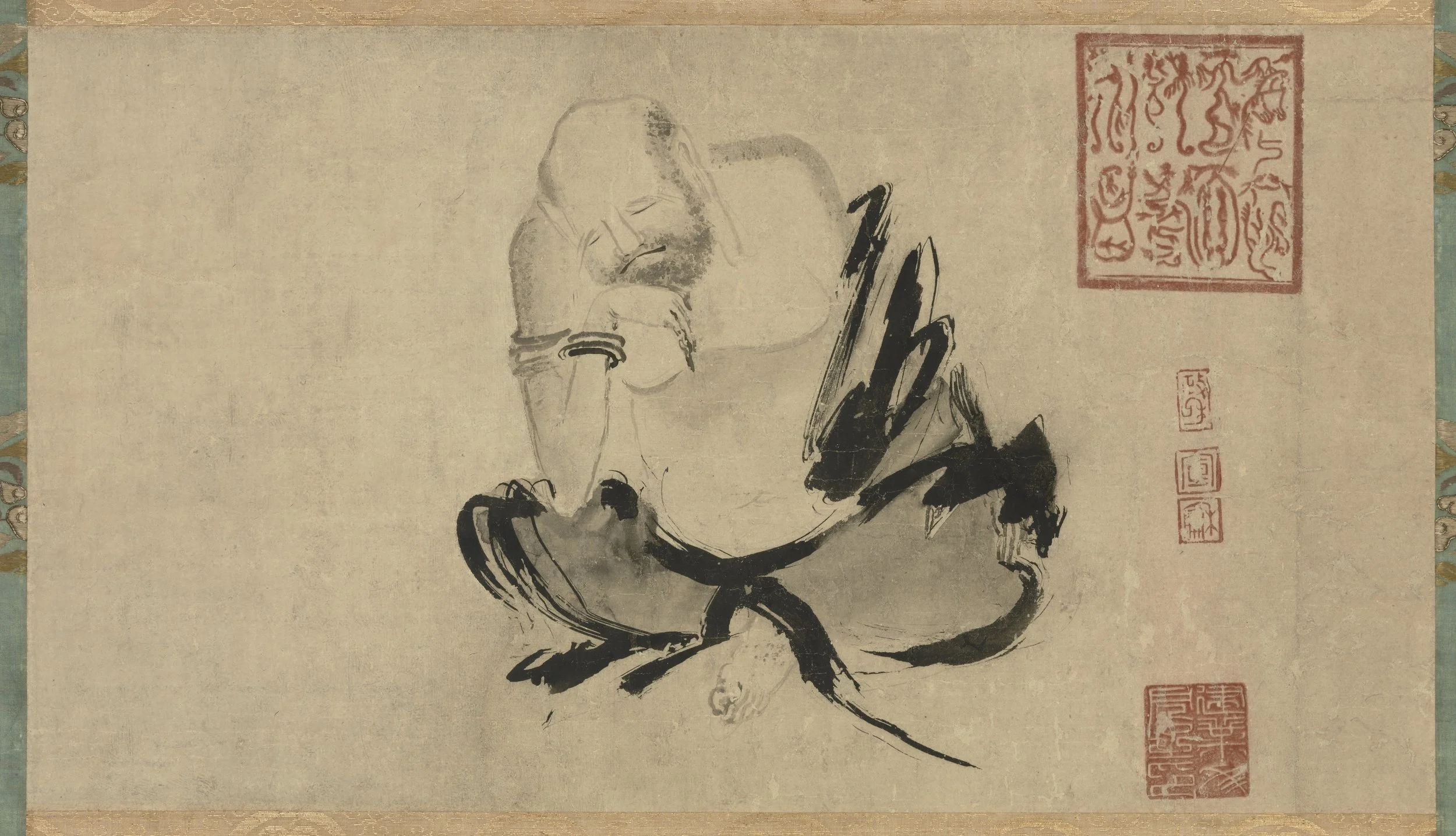
Zen monk Huike (慧可) thinking. By painter Shi Ke (Chinese: 石恪), from Five Dynasties and Ten Kingdoms Period to Northern Song (about 10th century)
Introduction
What kind of teaching becomes dangerous enough that someone bribes the authorities to kill the teacher?
In the seventh century, Bodhidharma’s successor, the Chan master Huike (HWAY-kuh), was slandered for possessing understanding-and-insight said to surpass the rest — insight that unsettled established centers of religious authority. Rivals sent emissaries to destroy his teaching community. When those emissaries heard him speak, they joined him instead. His opponents grew furious. He was accused of speaking “demonic words.” In the end, his opponents bribed the authorities to have him killed.
The biography does not portray Huike as a man who claimed office or defended rank. It records no appeal to institutional standing. Yet people sought him out as a teacher. Those sent to dismantle his community became his students. His authority did not rest on position, but on what the text calls a “deeply responsive mind” — discernment steady under changing conditions, teaching shaped within circumstances, and speech that matched conduct.
This account appears in the Continued Biographies of Eminent Monks (續高僧傳)[1], compiled in the Tang dynasty. It does not tell the story of a revolution. Instead, it preserves a tension: how a teaching moved through people rather than institutions, how clarity and discernment could carry authority without formal position, and how that recognition unsettled established hierarchies.
Historical Context
The Continued Biographies of Eminent Monks was compiled in the seventh century by the Tang monk Daoxuan (道宣, 596–667), a prominent vinaya scholar and historian of the monastic community. Intended as a continuation of earlier collections of eminent monks, the work brings together accounts of meditation masters, scholastics, translators, ascetics, and administrators from different regions and lineages.
Daoxuan was not writing a sectarian manifesto. His aim was documentary: to record conduct, reputation, disputes, and lines of transmission as they were remembered within living communities. The biographies do not lay out systematic doctrine. Instead, they recount episodes — encounters, accusations, endurance, persuasion — through which authority appears in practice rather than in theory.
The figure later remembered as Huike appears here at an early stage in what would become known as the Chan lineage. The institutional structures and fully developed patriarchal histories familiar from later centuries had not yet taken shape. Instead, we see a more fluid moment: authority is still contested, transmission is still embodied in personal relationships, and recognition grows out of encounter rather than official appointment.
Contemporary Rendering
The following is a contemporary rendering of the biography of Huike and his disciples as preserved in the Continued Biographies of Eminent Monks. The aim is clarity without smoothing away ambiguity. Key terms are rendered consistently, but the narrative structure and tensions of the original are retained.
Daoxuan, Xu Gaoseng Zhuan, T50, 2060, 551c27–552c25.
Śramaṇa Sengke, also named Huike, lay surname Ji, was a man of Hulao.
Outwardly he surveyed the classical writings; inwardly he was conversant with the canonical texts. In later years, while keeping to the way, he quietly watched the prevailing trends of the capital. He alone carried within him great illumination and understanding-and-insight, standing apart from others. Although accomplishing the way was nothing new in itself, people placed value on transmission from a recognized teacher. At that time, those with rank and reputation joined together in rejecting him.
Yet the provisional way does not rely on deliberate planning; when it comes together, that convergence shows itself soon enough. If one binds this essential point oneself, who can bind it?
At forty years of age, he encountered the śramaṇa Bodhidharma from Tianzhu, who was traveling and teaching in the Song and Luo regions. Ke, cherishing a treasure and knowing the way, was pleased with him at their first meeting and honored him as teacher. To the end of his life he received his intent. He studied with him for six years, thoroughly investigating the one vehicle.
Principle and affairs merged together; in suffering and ease there was no obstruction. His understanding was not expedient; discernment came forth from a subtle mind. Ke, responding to circumstances, worked and refined, kneading purity and impurity like clay, and only then knew. The force of what he did was firm and not overrun by circumstances.
Bodhidharma’s transformative activity came to an end on the banks of the Luo River. Ke also buried his form by the river’s edge.
Earlier, his good reputation had spread in proclamations throughout the capital region, so that those of the way and the laity came ceremonially, asking to follow him as teacher. Ke exerted his unusual eloquence and presented his essential point of mind. His words spread throughout the realm, yet his intent was not to establish anything. He widely surveyed mysterious texts, they had never occupied his mind.
Later, at the beginning of the Tianping era, he went north to Xin’ye and there opened up a hidden garden in full. Those attached to texts stirred up disputes of right and wrong. At that time there was a Chan master named Daoheng, who had previously studied concentration under Wang Zong in Ye and whose followers numbered in the thousands. When they heard Ke speak the dharma, their concerns had nowhere to rest, and they called it demonic speech. He then sent someone perceptive from among the assembly to destroy Ke’s gate. Once he arrived and heard the dharma, he remained calm and became inwardly convinced. Sorrow filled his breast, and he had no mind to return and report.
Heng summoned him again, yet he did not heed the command. Of those sent in succession, many went, and none returned. On another day he met Heng. Heng said, “I used so much effort to open your eyes. Why has this happened with all these messengers?”
He replied, “The eyes were originally correct. Because of the teacher, they went askew—that is all.”
Heng then deeply resented and slandered and harassed Ke. He bribed the secular authorities, and they unjustly put him to death. From the beginning to the point of death, Ke harbored not a single resentment. Heng’s assembly rejoiced. As a result, those who understood the root cut off superficial learning, while those who slandered and reviled took up knives against themselves. Only then did they come to see what a single utterance had conveyed; joy and fear mingled within them. Sea-traces and hoofprints, clear pools, shallow and deep — all were present there. Ke then loosened himself and acted in accord with ordinary ways.
At times he briefly entrusted clear counsel to chant and song. At times, because of circumstances, there was clarification and sifting; what had long been held was written out and cut away, and tangled excess cleared. Therefore, the correct way was distant and difficult to aspire to, while entanglements lay close at hand and were easily tied—there was reason for this.
He then wandered between Ye and Wei, frequently exchanging greetings. In the end, the way was obscure and dark. Thus, in later times there was no flourishing successor. There was a layman named Xiang, who withdrew into the forests and wilds, living on simple fare. At the beginning of the Tianbao era, the taste of the way was taken as the teacher.
He sent a letter to open friendly communication, saying: A shadow arises from form, and an echo follows a sound. To play with the shadow tires the form, not recognizing that the form itself is the shadow. To raise the voice in order to stop the echo is not to recognize that the sound is the root of the echo. To remove affliction and seek nirvana is like discarding the form and searching for the shadow; to leave sentient beings and seek a Buddha is like silencing the sound and searching for the echo. Therefore confusion and insight are one path, and the foolish and the wise are not separate.
No-name gives rise to name; from that name, judgments of right and wrong form. No principle gives rise to principle; from that principle, disputes emerge. Illusory transformations are not real—who, then, is right and who is wrong? Being false and without substance — what is emptiness, what is existence? One will come to see that gain involves no gain and loss involves no loss. Before entering into fuller discussion, I have briefly set forth this point, and I expect you will reply.” Ke then took up the brush and expressed his meaning, saying:
In speaking this true dharma, all is as it is; it is ultimately no different from the true and hidden principle. In original confusion, one takes a mani jewel for tiles and rubble; suddenly one becomes aware that it is a true pearl. Unclarity and wisdom are not different. One should know that the ten thousand dharmas are as they are. Pitying those who cling to these two views, I set down these words and take up the brush to compose this letter. Contemplate the body and the Buddha as not different—why must one further seek that which is “without remainder”?
When he spoke, his words were in accord with principle; nothing was added or embellished. At times others continued his words, and thus they were formed into sections, fully preserved in a separate scroll. At that time there were also Master Hua, Master Liao, Chan Master He, and others; each penetrated and surpassed what was dark and abstruse. Their words were clear and far-reaching, relying on events to convey their intent. These accounts were heard directly, yet in the human world, though not far removed, inscriptions and records are rarely found. If subtle words are not transmitted, who will record their virtue? This is deeply regrettable.
At that time there was Dharma Master Lin, who in Ye lectured extensively on the Śrīmālā and also composed explanations of its meaning. Whenever he lectured and people gathered, he selected those versed in three sūtras; their number reached seven hundred. They were sitting in his assembly. When the Zhou suppressed the teaching, he and Ke studied together and jointly protected sūtras and images. At first Chan Master Bodhidharma gave Ke the four-fascicle Laṅkā and said: “I observe that in the land of Han there is only this sūtra. If you rely on it and practice, you yourself will pass through the world.” Ke devoted himself exclusively to the subtle principle, as previously stated.
He encountered bandits who cut off his arm. Using the dharma to steady his mind, he did not feel pain or suffering. He burned the wound with fire; when the bleeding stopped, he wrapped it in cloth and begged for food as before. He never told anyone.
Later Lin was also attacked by bandits and had his arm hacked. He cried out through the night. Ke treated and wrapped the wound and begged for food to provide for Lin. Lin blamed Ke, blaming him for the way he was using his hand and became angry with him.
Ke said, “The cakes and food are before you; why not wrap it yourself?”
Lin said, “I have no arm. Do you not know?”
Ke said, “I also have no arm. Why then be angry?”
Because of this they questioned one another, and only then did Lin realize what Ke had endured. Thus the world called him “Armless Lin.”
Whenever Ke finished speaking the dharma, he would say, “After four generations, this sūtra will turn into names and forms. How deeply lamentable.” There was a Chan master named Na, whose secular surname was Ma. At twenty-one he was in Donghai lecturing on the Book of Rites and the Book of Changes. He had four hundred students engaged in study; traveling south to Xiangzhou, he encountered Ke speaking the dharma. He, together with ten of his students, left home and entered the path. The disciples held a farewell feast east of Xiangzhou, and the sound of weeping shook the town.
From the time he left lay life, his hand no longer held brush or secular writings. He wore only a single robe and kept a single bowl, sitting once and eating once a day, following Ke’s constant practice. He also maintained ascetic disciplines, and wherever he went he did not frequent towns or villages.
There was a man named Huiman, a native of Xingyang, surnamed Zhang, who had formerly resided at Longhua Monastery in Xiangzhou. Upon encountering Na speaking the dharma, he immediately entered his path and devoted himself exclusively to non-attachment.
He kept one robe and ate one meal a day, keeping only two needles. In winter he begged to patch his robe; in summer he cast off the rest and covered himself only in red cloth. He said that throughout his life he had no fear. His body had no lice, and when he slept he did not dream. He never stayed two nights in one place. When he arrived at a monastery, he split firewood and made sandals, constantly going about begging for food. In the sixteenth year of Zhenguan, he lodged beside Huishan Monastery south of Luozhou, in a cypress tomb.
He encountered snow three chi deep. The next morning he entered the monastery and met Dharma Master Tankuang. Tankuang wondered where he had come from. Man said, “Has a dharma friend come?” He sent someone to look for the place where he had sat. On all four sides, for about five chi, the snow had piled up of itself and could not be measured. When he heard that there was a search for monks in hiding, Man then took his robe and bowl and went around the villages without hindrance. As offerings came he dispersed them, seeking only emptiness and quiet. If there were those who invited him to lodge and dine, he would say, “Only when there is no one in the world will I accept your invitation.”
Therefore whenever Man spoke the dharma he said:
“The Buddhas speak of mind, to let one know that the marks of mind are illusory dharmas. Yet now we again add marks to mind, deeply going against the Buddha’s intent. Further increasing argument greatly departs from the great principle.” Therefore Na, Man, and others always carried the four-fascicle Laṅkā and took it as the essential point.
As they spoke, so they practiced, without deviation or omission. Later, in Luozhou at Taozhong, without illness he sat and passed away. His age was about seventy. These disciples were all of Ke’s lineage. Therefore Ke is recorded separately.
Summary and Key Themes
Read as a whole, the biography does not lay out a doctrine. Instead, it recounts a series of encounters. Emissaries sent to destroy his community remain and join him. Rivals denounce his words as “demonic,” then bribe the authorities to have him killed. Disciples adopt the way of life they see embodied.
Through these encounters, people recognize his insight — in speech that persuades, in his lack of resentment even as he faces execution, and in a life that embodies what is spoken.
Another thread runs alongside this narrative. The text warns against turning a teaching meant to challenge fixed ideas into something else to cling to. “The Buddhas speak of mind,” it says, “to show that mind’s marks are false.” In other words, the language is meant to point beyond itself — not to create another object of belief. Yet people respond by multiplying distinctions. Even scripture, Huike cautions, will “turn into names and forms.” What begins as guidance becomes something to argue over, defend, and build identity around.
Taken together, these episodes reveal a recurring pattern. The teaching passes from person to person — from Bodhidharma to Huike, and from Huike to monks who carry it forward in ordinary acts, splitting wood and making sandals. It is preserved, yet repeatedly risks being reduced to fixed doctrines, positions, and ranks.
Why It Matters Today
The tensions preserved in this seventh-century biography are not confined to its time. Traditions of all kinds face the same challenge: how to preserve what matters without turning it into rigid rules; how to guide others toward direct insight through words that are inevitably limited and open to misinterpretation; how to recognize genuine clarity and discernment without conflating it with rank or position.
These are not abstract concerns. They arise wherever teaching takes place. How does one honor a lineage without freezing it into formula? How does one speak, knowing that words will always fall short? How does one offer structure to a community while remaining responsive to the particular moment and the particular person?
Huike’s story does not resolve these tensions. It records what follows. Teaching that hardens into fixed doctrine can entangle itself in argument and breed hostility. Authority grounded only in institutional standing can be unsettled by lived clarity. And clarity that cannot be neatly contained may meet resistance from those invested in fixed forms.
What this account suggests — quietly, without proclamation — is that what sustains a tradition depends less on the solidity of its structures than on the integrity of those who live it. Speech aligned with practice. Authority tested under pressure. Transmission carried through persons rather than secured by rank.
The story does not romanticize disruption. It records slander, suffering, and death. But it leaves open a question that remains unsettled: can a teaching remain alive without becoming rigid — and if so, at what cost?
Perhaps that is why the biography ends not with triumph but with conduct: a man facing execution without resentment, a teaching carried forward in ordinary acts, words spoken and lived without deviation. The text does not resolve the tension it records. It simply preserves it.
A Note on Translation
The contemporary rendering above aims for clarity while preserving the structural tensions and ambiguities of the original text. Key terms are translated consistently, and doctrinally charged language has been rendered with restraint in order to avoid importing later interpretations. Where the Chinese leaves relationships or metaphysical claims undefined, the translation does not attempt to resolve them.
The line-by-line translation provided in the appendix follows the original more literally and preserves grammatical structure and phrasing as closely as possible. It is included for transparency and comparison.
Appendix
Literal line-by-line translation
Daoxuan, Xu Gaoseng Zhuan, T50, 2060, 551c27–552c25.
釋僧可。
Śramaṇa Sengke.
一名慧可。
Also named Huike.
俗姓姬氏。
His lay surname was Ji.
虎牢人。
A man of Hulao.
外覽墳[33]素內通藏典。
Externally he surveyed classical writings; internally he was conversant with the canonical texts.
末[34]懷道京輦默觀時尚。
Later, holding the Way in mind, in the capital he silently observed the fashions of the time.
獨蘊大照解悟絕群。
Alone he contained great illumination; his understanding and insight surpassed the multitude.
雖成道非新。
Though accomplishing the Way was not new,
而物貴師受。
yet people valued receiving it from a teacher.
一時令望咸共非之。
For a time his reputation was such that all together criticized him.
但權道無謀顯會非遠。
Yet in the provisional Way there was no scheme; manifest meeting was not far off.
自結斯要誰能繫之。
If one ties this essential point oneself, who can bind it?
年登四十。
When he reached forty years of age,
遇天竺沙門菩提達摩遊化嵩洛。
he encountered the śramaṇa Bodhidharma from Tianzhu, who was traveling and teaching in Song and Luo.
可懷寶知道一見悅之。
Ke, cherishing a treasure and knowing the Way, upon one meeting was pleased with him.
奉以為師。
He honored him as teacher.
畢命承旨。
To the end of his life he received his intent.
從學六載精究一乘。
He studied with him for six years, thoroughly investigating the one vehicle.
理事兼融苦樂無滯。
Principle and affairs merged together; in suffering and ease there was no obstruction.
而解非方便慧出神心。
His understanding was not expedient; discernment issued from a subtle mind.
可乃就境陶研淨穢埏埴方知。
Ke then, in response to conditions, molded and refined; kneading purity and impurity like clay, only then did he know.
力用堅固不為緣陵。
The functioning of his strength was firm, not overrun by conditions.
達摩滅化洛濱。
Bodhidharma ceased transforming at the banks of the Luo.
可亦埋形河涘。
Ke likewise buried his form by the river’s edge.
而昔懷嘉譽傳檄邦畿。
And formerly, holding fine reputation, proclamations spread through the capital region.
使夫道俗來儀請從師範。
Thus those of the Way and the laity came with ceremony, requesting to follow his model as teacher.
可乃奮其奇辯呈其心要。
Ke then exerted his unusual eloquence and presented his essential point of mind.
故得言滿天下意非建立。
Thus his words filled the realm, yet his intent was not to establish anything.
玄籍遐覽未始經心。
Though he widely surveyed mysterious texts, they had never passed through his mind.
後以天平之初。
Later, at the beginning of the Tianping era,
北就新鄴盛開祕苑。
he went north to Xinye and greatly opened a hidden garden.
滯文之徒是非紛舉。
Those attached to texts raised disputes of right and wrong in confusion.
時有道恒禪師。
At that time there was Dhyāna Master Daoheng.
先有定學王宗鄴下。
Previously he had learning of concentration under Wang Zong in Ye.
徒侶千計。
His followers numbered in the thousands.
承可說法情事無寄。
When they heard Ke speak the dharma, their feelings and circumstances had nowhere to attach.
謂是魔語。
They called it demonic speech.
乃遣眾中通明者。
So he sent one among the assembly who was perceptive and clear,
來殄可門。
to eliminate Ke’s gate.
既至聞法泰然心服。
When he arrived and heard the dharma, he was at ease and inwardly convinced.
悲感盈懷無心返告。
Sorrow and feeling filled his breast; he had no mind to return and report.
恒又重喚亦不聞命。
Heng summoned him again, yet he did not heed the command.
相從多使皆無返者。
Of those sent in succession, many went, and none returned.
他日遇恒。
On another day he met Heng.
恒曰。我用爾許功夫開汝眼目。
Heng said, “I used so much effort to open your eyes.
何因致此諸使。
For what reason has this led to these various missions?”
答曰。眼本自正。
He answered, “The eyes were originally correct.
因師故邪耳。
Because of the teacher they became skewed, that is all.”
恒遂深恨謗惱於可。
Heng then deeply resented and slandered and harassed Ke.
貨[6]賕俗府非理屠害。
He bribed the secular authorities, and unlawfully slaughtered him.
初無一恨幾其至死。
At first there was not a single resentment; he almost reached death.
恒眾慶快。
Heng’s assembly rejoiced.
遂使了本者絕學浮華。
Thus those who understood the root cut off the superficiality of learning.
謗黷者操刀自擬。
Those who slandered and defiled took up knives against themselves.
始悟一音所演。
Only then did they realize what had been expounded in a single sound.
欣怖交懷。
Joy and fear intermingled in their breasts.
海迹蹄瀅淺深斯在。
Sea-traces and hoof-prints, clarity and depth—there they were.
可乃縱容順俗。
Ke then indulged and accorded with the common ways.
時惠清猷乍託吟謠。
At times he bestowed pure guidance, briefly entrusting it to chanting and song.
或因情事澄[8]汰恒抱寫[9]割煩蕪。
Or according to feelings and events he cleared and sifted, always holding and expressing, cutting away tangled overgrowth.
故正道遠而難希。
Therefore the correct Way was distant and difficult to hope for,
封滯近而易結。
while sealing and obstruction were near and easy to bind.
斯有由矣。
There was a reason for this.
遂流離鄴衛亟展寒溫。
He then drifted between Ye and Wei, repeatedly passing through cold and warmth.
道竟幽而且玄。
The Way in the end was obscure and also dark.
故末緒卒無榮嗣有向居士者。
Therefore in the final thread there was no flourishing heir; there was a layman Xiang.
幽遁林野木食。
He withdrew into forests and fields and ate wood.
於天保之初道味相師。
At the beginning of Tianbao, the flavor of the Way served mutually as teacher.
致書通好曰。
He sent a letter to communicate goodwill, saying:
影由形起響逐聲來。
Shadow arises from form; echo follows sound.
弄影勞形。不知形之是影。
Playing with shadow wearies the form, not knowing that form is the shadow.
揚聲止響。不識聲是響根。
Raising the voice to stop the echo, not recognizing that the sound is the root of the echo.
除煩惱而求涅槃者。
To remove vexations and seek nirvāṇa
喻去形而覓影。
is like leaving form and searching for shadow.
離眾生而求佛喻默聲而尋響。
To leave living beings and seek Buddha is like silencing sound and seeking echo.
故迷悟一途愚智非別。
Therefore delusion and clarity are one path; the foolish and the wise are not distinct.
無名作名。
Without name, making names—
因其名則是非生矣。
because of names, right and wrong arise.
無理作理。
Without principle, making principle—
因其理則諍論起矣。
because of principle, disputes arise.
幻化非真誰是誰非。
Illusory transformation is not real—who is right, who is wrong?
虛妄無實何空何有。
Empty falsity has no substance—what is empty, what is existent?
將知得無所得失無所失。
One should know: in gaining there is nothing gained; in losing there is nothing lost.
未及造談聊伸此意。
Before entering into discussion, I merely extend this meaning.
想為答之。
I imagine you will answer it.
可命筆述意曰。
Ke took up the brush and set forth his meaning, saying:
說此真法皆如實。
Speaking this true dharma is all according to what is so.
與真幽理竟不殊。
With the true hidden principle it is ultimately not different.
本迷摩尼謂瓦礫。
Originally confused, one takes a mani jewel for rubble.
豁然自覺是真珠。
Suddenly one notices of oneself it is a true pearl.
無明智慧等無異。
Non-brightness and discernment are equal, without difference.
當知萬法即皆如。
One should know the ten thousand dharmas are all thus.
愍此二見之徒輩。
Pitying these groups of two views,
申詞措筆作斯書。
I extend words and set down the brush to make this writing.
觀身與佛不差別。
Contemplate the body and Buddha as not different.
何須更覓彼無餘。
Why must one further seek that without remainder?
其發言入理未加鉛墨。
When he uttered words entering principle, they were not yet added with ink.
時或纘之。
At times others continued them.
乃成部類。
Thus sections were formed.
具如別卷。
All are as in a separate scroll.
時復有化公廖公和禪師等。
At that time there were also Master Hua, Master Liao, Chan Master He, and others.
各通冠玄奧。
Each was thoroughly versed and outstanding in what is dark and profound.
吐言清逈托事寄懷。
They spoke words clear and far-reaching, entrusting matters to convey what was held within.
聞諸口實。
What was heard was based on spoken accounts.
而人世非遠碑記罕聞。
Yet in the human world not far away, stele records are seldom heard.
微言不傳清德誰序。
Subtle words are not transmitted; who will set in order pure virtue?
深可痛矣。
It is deeply to be lamented.
時有林法師。
At that time there was Dharma Master Lin,
在鄴盛講勝鬘并制文義。
who in Ye extensively lectured on the Śrīmālā and also composed textual meanings.
每講人聚乃選通三部經者。
Whenever he lectured and people gathered, he selected those versed in three sūtras;
得七百人。
there were seven hundred people.
預在其席。
They were present at his seat.
及周滅法與可同學共護經像。
When the Zhou suppressed the teaching, he and Ke studied together and jointly protected sūtras and images.
初達摩禪師以四卷楞伽授可曰。
At first Chan Master Bodhidharma gave Ke the four-fascicle Laṅkā and said:
我觀漢地惟有此經。
“I observe that in the land of Han there is only this sūtra.
仁者依行自得度世。
If you rely on it and practice, you yourself will cross the world.”
可專附玄理如前所陳。
Ke exclusively attached himself to dark principle as previously stated.
遭賊斫臂。
He encountered bandits who cut off his arm.
以法御心不覺痛苦。
Using dharma to govern the mind, he did not notice pain or suffering.
火燒斫處血斷帛裹乞食如故。
He burned the cut place with fire; when the bleeding stopped he wrapped it in cloth and begged for food as before.
曾不告人。
He never told anyone.
後林又被賊斫其臂。
Later Lin was also cut on the arm by bandits.
叫號通夕。
He cried out through the night.
可為治裹乞食供林。
Ke treated and wrapped it and begged food to supply Lin.
林怪可手不便怒之。
Lin, finding Ke’s hand not convenient, became angry at him.
可曰。餅食在前何不自裹。
Ke said, “The cakes and food are before you; why not wrap it yourself?”
林曰。我無臂也。
Lin said, “I have no arm.
可不知耶。
Do you not know?”
可曰。我亦無臂。
Ke said, “I also have no arm.
復何可怒。
Why again be angry?”
因相委問方知有功。
Because of this they entrusted and asked one another and only then knew there was merit.
故世云無臂林矣。
Thus the world called him Armless Lin.
每可說法竟曰。
Whenever Ke finished speaking the dharma he would say:
此經四世之後變成名相。
“This sūtra, after four generations, will turn into names and marks.
一何可悲。
How very lamentable.”
有那禪師者。
There was a Chan Master Na,
俗姓馬氏。
whose lay surname was Ma.
年二十一居東海講禮易。
At twenty-one he dwelt in Donghai lecturing on the Rites and the Changes.
行學四百南至相州遇可說法。
He traveled and studied with four hundred; going south to Xiangzhou he encountered Ke speaking the dharma.
乃與學士十人出家受道。
He then with ten scholars left home and received the Way.
諸門人於相州東設齋辭別哭聲動邑。
The various disciples set up a feast east of Xiangzhou to take leave; the sound of weeping moved the town.
那自出俗。
From the time Na left lay life,
手不執筆及俗書。
his hand did not hold brush nor secular writings.
惟服一衣一𭽽。
He wore only one robe and one bowl.
一坐一食以可常行。
One sitting, one meal, taking Ke’s constant practice as model.
兼奉頭陀。
He also upheld dhutāṅga practices.
故其所往不參邑落。
Therefore wherever he went he did not mix with villages.
有慧滿者。
There was one Huiman,
滎陽人。
a man of Xingyang.
姓張。
Surname Zhang.
舊住相州隆化寺。
Formerly he dwelt at Longhua Monastery in Xiangzhou.
遇那說法便受其道專務無著。
Encountering Na speaking the dharma, he received his Way and devoted himself exclusively to non-attachment.
一衣一食但畜二針。
One robe, one meal; he kept only two needles.
冬則乞補。
In winter he begged to mend.
夏便通捨覆赤而已。
In summer he completely gave away, covering himself with red only.
自述一生無有怯怖。
He himself said that in his whole life there was no fear.
身無蚤虱睡而不夢。
On his body there were no fleas or lice; when sleeping he did not dream.
住無再宿。
Where he stayed he did not lodge twice.
到寺則破柴造履。
Arriving at a monastery he split firewood and made sandals.
常行乞食。
He constantly went begging for food.
貞觀十六年。
In the sixteenth year of Zhenguan,
於洛州南會善寺側宿栢墓中。
at the side of Huishan Monastery south of Luozhou he lodged in a cypress grave.
遇雪深三尺。
He encountered snow three chi deep.
其旦入寺見曇曠法師。
The next morning he entered the monastery and met Dharma Master Tankuang.
怪所從來。
He wondered where he had come from.
滿曰。法友來耶。
Man said, “Has a dharma friend come?”
遣尋坐處。
He sent someone to look for the sitting place.
四邊五尺許雪自積聚不可測也。
On all four sides, about five chi, snow had piled up of itself and could not be measured.
故其聞有括訪諸僧逃隱。
When he heard there was a search for monks in hiding,
滿便持衣𭽽周行聚落無可滯礙。
Man then took his robe and bowl and went around the villages without obstruction.
隨施隨散索爾虛閑。
As offerings came he immediately dispersed them, seeking only emptiness and leisure.
有請宿齋者。
If there were those who invited him to lodge and dine,
告云。天下無人方受爾請。
he would say, “Only when there is no person in the world will I accept your invitation.”
故滿每說法云。
Therefore whenever Man spoke the dharma he said:
諸佛說心。
“The various Buddhas speak of mind,
令知心相是虛妄法。
to let one know that mind’s marks are false dharmas.
今乃重加心相。
Now again adding mind’s marks
深違佛意。
deeply goes against the intent of Buddha.
又增論議殊乖大理。
Further increasing disputation greatly departs from the great principle.”
故使那滿等師常齎四卷楞伽以為心要。
Therefore Na, Man, and others always carried the four-fascicle Laṅkā as the essential point of mind.
隨說隨行不爽遺委。
As they spoke so they practiced, without error or omission.
後於洛陶中無疾坐化。
Later, in Luoyang Taozhong, without illness he sat and transformed.
年可七十。
His age was about seventy.
斯徒並可之宗系。
These disciples were all of Ke’s lineage.
故可別敘。
Therefore Ke is separately recorded.
Footnotes
1. Daoxuan 道宣. Xu Gaoseng Zhuan 續高僧傳, scroll 16, “Shi Sengke zhuan” 釋僧可傳. In Taishō Shinshū Daizōkyō 大正新脩大藏經, vol. 50, no. 2060, 551c27–552c25. Edited by Takakusu Junjirō et al. Tokyo: Taishō Issaikyō Kankōkai, 1924–1934. Digital edition, CBETA 2025.R3.
Bibliography
Daoxuan 道宣. Xu Gaoseng Zhuan 續高僧傳. In Taishō Shinshū Daizōkyō 大正新脩大藏經, vol. 50, no. 2060. Edited by Takakusu Junjirō 高楠順次郎 et al. Tokyo: Taishō Issaikyō Kankōkai, 1924–1934. Digital edition, Chinese Buddhist Electronic Text Association (CBETA), 2025.R3.
